[He], Napoleon, was only now for the first time announcing it—that the name ‘Animal Farm’ had been abolished. Henceforward the farm was to be known as ‘The Manor Farm’—which, he believed, was its correct and original name.
Likely one of the most banned books of the twentieth century, this novella was written as a satire of a real-life revolution and has become a cautionary tale about how easily political order falls apart. It shows us the full cycle, from decay to improvement and decay again, critiquing how societies lose their ability to recognise the change until they return to a situation similar to the one they once craved to leave behind. I’m talking about Animal Farm by George Orwell.
Let’s get this book undone.
Hello everyone, and welcome to Books Undone. I’m your host, Livia J. Elliot, and today I want to offer you a fairly unconventional take on Animal Farm by George Orwell. Instead of analysing it as a satire of a very specific real-life revolution, this episode will centre on a meta-critique the novel enables: that every system of political order decays, is upturned (either violently or in a more pacifist way), to truly serve the well-being of its society… for a time; after that, political order decays again.
I will first tell you about the author, George Orwell, whose life experiences cannot be extricated from his books. Then, we will discuss the real-life inspiration for this novel, and finally dive into the thematic discussion.
As usual, before diving in, allow me some housekeeping:
- Spoilers ahead. I’ll be discussing major elements of Animal Farm, and though I’ll try my best to cover the book in a way that does not require prior reading, you may find this more accessible if you have read it.
- I also bring quotes from different essays written by Orwell himself, mentioning real-life events alongside with the author’s opinions—statements that were controversial at the time he wrote them. I will aim to provide enough historical context for this to be meaningful.
- This is one interpretation. What follows is my personal reading of Animal Farm. George Orwell was quite explicit about who and what he was critiquing. That said, re-reading this for the
nthtime gave me an idea… and I decided to bring this unusual interpretation into the podcast.
That said, let us begin with…
The Author, George Orwell.
His real name was Eric Arthur Blair, and he was born in 1903 in India during the English Administration. He secured a scholarship to an English Public School—“the most costly and snobbish” one, as he referred to it1—and after finishing it, he relocated to Burma to join the Indian Imperial Police. What he experienced in that service was later narrated in Burmese Days, one of Orwell’s early, non-fiction works.
In 1927, while on leave in England, he resigned to that service and during 1928-1929 lived in Paris in poverty—writing stories that “nobody would print”1 (though I suspect some of this may have later become Out And About in Paris and London). By 1936, Orwell—or, better said, Eric Arthur Blair—came to the attention of the Special Branch of MI5. The reason? He was researching the harsh living conditions among the working class in Lancashire and Yorkshire to write The Road to Wigan Pier2.
It’s not strange he had caught the MI5’s attention. His non-fiction work covered social conditions that offered a less-than-favourable outlook on the work of the English monarchy of the time, and his political ideas… well, they did not please the government either. Consider this: in 1936, that very same year the MI5 began tracking him, Orwell travelled with his newlywed wife to Spain amidst the civil war where they both joined the fight in favour of the Spanish Government. They fought, they lost friends, and by 1937 the couple had to escape back to London.
Between August 1941 to November 1943, and despite still being under surveillance (for it seems to have lasted twelve years), Orwell worked for the BBC Eastern Service as a propagandist. There, he became aware of the power of propaganda, which also informed his understanding of how language can be used to manipulate and control people—and this, as you may have guessed, eventually ‘inspired’ him to develop Newspeak and write 1984.
During this time Orwell also noted some sort of status quo in the publishing world which seemed to avoid the publications of specific political topics. He did not think that this happened because of a politically-driven censorship. On the contrary, he deemed it self-imposed by the media itself. In Orwell’s own words, taken from his preface-essay The Freedom of the Press3:
If publishers and editors exert themselves to keep certain topics out of print, it is not because they are frightened of prosecution, but because they are frightened of public opinion.
You will notice that ‘public opinion’ will come back in our discussion of Animal Farm. However, it is natural to ask: which specific topics did he see censored? What irked him so much? Again, in his own words3:
The sinister fact about literary censorship in England is that it is largely voluntary. […] Hardly anyone will print an attack on Stalin, but it is quite safe to attack Churchill, at any rate, in books and periodicals. […] There are other forbidden topics, and I shall mention some of them presently, but the prevailing attitude towards the USSR is much the most serious symptom.
Why was he complaining about Stalin, a Russian dictator? Because England’s status quo of censorship towards so-called ‘unbecoming’ news was quite strict about news involving Russian affairs, avoiding publications that cast it in a less-than-favourable light. When Orwell wrote Animal Farm he struggled to find a publisher because, at its core…
Animal Farm is a satire of the Russian Revolution.
Which means that, to understand the themes in this novel, we must first review a bit of history.
At the start of the twentieth century Russia was, like many other countries, still a monarchy—and it wasn’t enjoying its most comfortable life conditions either. In 1905, burst the First Russian Revolution, characterised by mass political and social unrest including worker strikes, peasant revolts, and military mutinies directed against Tsar Nicholas II and the autocracy. In response, the tsar issued the famous October Manifesto, which led to a number of reforms in the path towards a constitutional monarchy. However, in 1914, when the Ottoman Empire entered the First World War on the side of the Central Powers, Russia was deprived of a major trade route, which worsened its still-unsolved economic crisis and munitions shortages.
Many historians contend that the Revolution of 1905 set the stage for the two revolutions of 1917, which happened in the midst of World War I. In February of that year, driven by a mix of war exhaustion, military defeats, bread shortages, and strikes in Petrograd, the Tsar abdicated under pressure once his own generals withdrew their support; this became known as the February Revolution. A Provisional Government was installed, made up of liberals and moderate socialists, while the Petrograd Soviet acted as a rival power base—initially dominated by Mensheviks and SRs, but won over by the Bolsheviks by autumn 1917. Of course, they used it to organise opposition to the Provisional Government rather than share power with it. Thus, in October of that same year, Vladimir Lenin, the Bolsheviks’ leader, seized power in what came to be known as the Bolshevik Revolution.
The government that succeeded the constitutional monarchy presented itself as socialist, though the Bolshevik Party was later renamed the Russian Communist Party, All-Union Communist Party, and ultimately the Communist Party of the Soviet Union.
All in all, the Bolshevik Revolution—and the events leading to it—is considered to be a key event of the twentieth century, perceived as a rupture with imperialism and afterwards influencing many other revolts and sociopolitical structures. It matters, for the purpose of this podcast, because as Orwell himself wrote1:
Although the various episodes [of Animal Farm] are taken from the actual history of the Russian Revolution, they are dealt with schematically and their chronological order is changed; this was necessary for the symmetry of the story.
…and as many literary scholars have demonstrated, a large part of Animal Farm’s cast can be equated either to specific people that were part of this Revolution (such as Lenin himself), or to the social groups that existed during it4.
However, as I hinted at the very beginning, I’d like to present a different analysis of this novel. To do this…
We must take a step back from the events it satirises, to consider the stages of political order before and after the Revolution.
And I do not mean the Russian Revolution (though we cannot fully detach ourselves from it) but the Revolution the animals conducted in Manor Farm, originally under the rule of Mr Jones and his four nameless farmhands. This is what the novel tell us:
In past years Mr Jones, although a hard master, had been a capable farmer, but of late he had fallen on evil days. He had become much disheartened after losing money in a lawsuit and had taken to drinking more than was good for him. For whole days at a time he would lounge in his Windsor chair in the kitchen, reading the newspapers, drinking, and occasionally feeding [his pet raven] on crusts of bread soaked in beer. His men were idle and dishonest, the fields were full of weeds, the buildings wanted roofing, the hedges were neglected and the animals underfed.
Animal Farm may be a satire, but it is told in the cadence and style of fables—which tend to offer overarching narratives that, at times, fast-forward to several years of events in a single paragraph. This is exactly what this excerpt was doing, so let us break it down:
- Notice the first detail: “In the past years Mr Jones, although a hard master, had been a capable farmer, but of late he had fallen on evil days”. This was the original political order of Manor Farm: an equilibrium of sorts between Mr Jones (as the owner) and the animals that worked for him and he, in turn, cared for. At that point, the animals were not rejoicing in opulence, but they weren’t off that bad… or, at least, that’s what the collective memory narrating this overview of their history believed. There was some struggle, which is inevitable in society, but there wasn’t constant misery.
- Yet this order slowly changed because Mr Jones “had become much disheartened after losing money in a lawsuit and had taken to drinking more than was good for him.” Which means that something external happened to him—geopolitics, anyone?—and he began to rely on alcohol as a coping mechanism.
- He neglected his duties towards the farm and the animals—since “[f]or whole days at a time he would lounge in his Windsor chair”—leaving his farmhands to do what they pleased. But these men “were idle and dishonest”, thus exacerbating the neglect. A problematic behaviour, given the animals depended on Mr Jones: needing to be fed, the cows to be milked, the hay replaced, the rats and foxes chased away.
- Here begins the allegorical form of infrastructure being left unattended and not invested upon enough—namely, the buildings and tools around the farm—and the living conditions left to decline into a harrowing state. After all, “underfed” does not mean hardship; it means a basic need now unfulfilled.
If we take into account that (a) the character of Mr Jones aimed to satirise the Russian Tsar Nicholas II, and (b) Mr Jones was not just a man but the ruler of the farm and thus the one with absolute control over what happened to the animals within it… then the excerpt I read above stops being a story about personal decline, and becomes one of political decay. Why? Because in an absolutist, one-man system, there is no separation between the ruler’s state and the state’s institutions to begin with.
Mr Jones was the—monarchic, if one wills—political order, and it was now decaying.
Francis Fukuyama, an American political scientist, suggested that decay “occurs when political systems fail to adjust to changing circumstances”5—and within the book, the lawsuit brought “changing circumstances” (likely the need to increase income in order to pay debts). Mr Jones failed to adapt the farm’s inner workings to both (a) pay the debt, while (b) keeping the animal’s working conditions sustainable. Hence, decay exacerbated.
But as everything worsened, the animals… well, the animals simply endured, perhaps without even considering that their situation was not adequate at all. It may sound shocking, but this reaction is not entirely fictional. Fukuyama argued that “there is often a substantial lag between changes in the environment that should trigger institutional change, and the actual willingness of societies to make those changes”5. Stagnation is real, and a society’s lack of perspective is as well… especially when its people are so concerned with ‘surviving the next day’ that they have no time (or means) to track progress in any representative way.
It is at this point of political decay that, one night, the animals of Manor Farm gathered to listen what Old Major—an old and renowned boar—had to say. His speech began with this:
Now, comrades, what is the nature of this life of ours? Let us face it, our lives are miserable, laborious, and short. We are born, we are given just so much food as will keep the breath in our bodies, and […] the very instant our usefulness has come to an end, we are slaughtered with hideous cruelty. […] the life of an animal is misery and slavery: that is the plain truth. […] Why do we continue in this miserable condition? Because nearly the whole of the produce of our labor is stolen from us by human beings. There, comrades, is the answer to all our problems. It is summed up in a single word—Man.
Old Major voiced what everyone experienced but had not truly considered or discussed until then. Scarcity abounded, the animals were starving and forced into harsh conditions, sickness and ailments were common, and the mortality rate was quite high… especially if you consider the mini-allegory of the hens having to ‘give up’ their eggs in order to produce income.
Yet to the animals—the collective they represent, regardless of their ‘roles’ in the farm—this was how things had always been. After all, “animals live short lives” and none of them could remember a time when the living conditions have been different… and yes, we humans do live “short lives”, if we compare our lifespan to that of a nation or any other political system. There had been empires that lasted centuries.
Perhaps aware of this lack of perspective, Old Major ends his speech by sowing one idea:
What then must we do? Why, work night and day, body and soul, for the overthrow of the human race! That is my message to you, comrades: Rebellion!
Rebellion. Revolution.
Fukuyama argued that “violence constantly remains as a background condition for certain types of political change”5 because, reached a point of political stagnation, when the government is so decayed it lacks an internal mechanism for reform, revolution becomes the only exit from that status quo. By the time Old Major gave his speech to the other animals, Mr Jones—at least from the animal’s perspective, and much like the Russian Tsar—was past redemption.
However, Old Major must have known that his proposal would fade into oblivion because of the inaction so ingrained in the animals. Thus, for the rebellion to happen the animals needed a motivation—a dream, if it can be called that, or a goal—to have something to fight for. This is why Old Major’s speech ended with this:
Man serves the interests of no creature except himself. And among us animals let there be perfect unity, perfect comradeship in the struggle. All men are enemies. All animals are comrades. […] And remember also that in fighting against Man, we must not come to resemble him. […] No animal must ever live in a house, or sleep in a bed, or wear clothes, or drink alcohol, or smoke tobacco, or touch money, or engage in trade. […] No animal must ever kill any other animal. All animals are equal.
Old Major was doing three interesting things:
- He gave the animals a common enemy: humankind. This was vaster than just Mr Jones, and as a target of hate and fear, “humankind” was longer-lived as well. After all, it encompassed any other human, including the owners of the neighbouring farmlands; were Mr Jones to meet his end, the animal-vs-humans hatred would still be applicable.
- He sowed the basics of the dream needed as motivation: the idea that all animals are equal and no animal must ever kill any other animal, remaining in perfect unity even during struggle. The fellows of Manor Farm had not experienced this before, since the cat chased rats, the dogs barked and growled at sheep, the pigs drank the cows’ milk, and so on.
- Beyond the dream, Old Major simultaneously described prohibitions—not living in a house, not sleeping in a bed, nor wearing clothes or drinking alcohol, not smoking tobacco, not touching human money nor engaging in trade—that were not promises of what the animals could achieve after the rebellion, but ‘regulations’ about what they should never do not to become human-like—not even after a successful rebellion. These were, we could argue, parameters to further the animals-vs-humans distinction.
Most animals just accepted what Old Major proclaimed, cheered at the end of his speech, then sang the song he taught before scampering when Mr Jones unwillingly interrupted them. Yet soon after the old boar passed away, three specific pigs—Napoleon, Snowball, and Squealer—seem to have decided the Rebellion had to happen, and set upon themselves a different task:
These three had elaborated Old Major’s teachings into a complete system of thought, to which they gave the name of Animalism. Several nights a week, after Mr Jones was asleep, they held secret meetings in the barn and expounded the principles of Animalism to others. […] Their most faithful disciples where the two cart-horses, Boxer and Clover.
What Napoleon, Snowball, and Squealer did was to create an ideology. An ideology (according to the Routledge Encyclopedia of Philosophy) is “a set of ideas, beliefs and attitudes, consciously or unconsciously held, which reflects or shape understandings or misconceptions of the social and political world”6. This is what Old Major had done—putting into words his understanding of how this farm, this society, should work in order to be ‘fair’ to the animals. The three pigs, “who were generally recognised as being the cleverest of the animals”, understood the need for an ideology and so used his words to develop the Seven Commandments of Animalism.

They taught it to the other animals with varying degrees of success, but eventually decided that Animalism could be summarised into a single principle:
Four legs good, two legs bad.
—which required them to think of a bird’s wings as a type of ’leg’. Regardless of that hiccup, all the animals began to learn it by heart, and soon enough the sheep became the most adept at bleeting this motto whenever was needed.
Why, one may ask? The book—the collective narrative—never dives into the pigs’ motivations, but:
- (a) we can argue that the pigs needed to solidify the dream Old Major had proposed, along with the prohibitions that differentiated animals from their human enemies, because
- (b) ideologies are needed for revolutions. As the Routledge Encyclopedia of Philosophy tells us, an ideology serves “to recommend, justify or endorse collective action aimed at preserving or changing political practices and institutions”6.
At this point, the pigs had everything that was needed. A current political order in evident decay—namely, Mr Jones’s rule—the goal of a rebellion as collective action, and Animalism as the ideology motivating the others and justifying their actions. It was only a matter of time, and so Mr Jones’s next failure became the trigger in a farm that was already done with him:
On Midsummer’s Eve, which was a Saturday, Mr Jones went into Willingdon and got so drunk at the Red Lion that he did not come back till midday on Sunday. The men had milked the cows in the early morning and then had gone out rabbiting, without bothering to feed the animals. When Mr Jones got back he immediately went to sleep on the drawing-room sofa with the News of the World over his face, so that when evening came the animals were still unfed. At last they could stand it no longer. One of the cows broke in the door of the store-shed with her horn and all the animals began to help themselves from the bins. It was just then that Mr Jones woke up. The next moment he and his four men were in the store-shed with whips in their hands, lashing out in all directions. This was more than the hungry animals could bear. With one accord, though nothing of the kind had been planned beforehand, they flung themselves upon their tormentors.
Any similarity with reality was probably Orwell’s intention.
That said—and again using Fukuyama’s work to understand this—“scarcity of land or access to certain key public resources” (which, in the case of Animal Farm was the food) “are much more likely to trigger conflicts,” (especially when the pigs have everything ready) “which then might require more centralised forms of political authority to control.”
Remember that Mr Jones satirised the absolutist power of the Tsar; there were no institutions because he—the monarch—was the institutions… and he was weakened, in particular drunk, at the moment the cows broke into the shed. His minions, the farmhands, had “gone rabitting” and were also drunk—which we can understand as whatever enforcement forces a monarch may have had. As a result, there was no centralised political authority to exert any control over the rampant population of animals, and so:
[…] almost before they knew what was happening, the Rebellion had been successfully carried through; Jones was expelled, and the Manor Farm was theirs.For the first few minutes the animals could hardly believe in their good fortune. Their first act was to gallop in a body right round the boundaries of the farm, as though to make quite sure that no human being was hiding anywhere upon it; then they raced back to the farm buildings to wipe out the last traces of Jones’s hated reign.
Thus began a new political order in Manor Farm
—which was promptly renamed into Animal Farm. At first there were celebrations:
The animals rushed to the top of it and gazed round them in the clear morning light. Yes, it was theirs—everything that they could see was theirs! In the ecstasy of that thought they gambolled round and round, they hurled themselves into the air in great leaps of excitement.
But notice this: “It was theirs—everything that they could see was theirs!” The animals, as a collective, did not revolt against Mr Jones to impose another ruling class upon them. If you remember Old Major’s original speech, the dream was clear: “And among us animals let there be perfect unity, perfect comradeship in the struggle.” They were going, as a collective of equals, to control the farm and decide about its fate by voting—which is precisely why the last principle of Animalism said: “all animals are equal”7.
The narrative is quite explicit about this expectation, referring to the animals as a collective:
[T]hey made a tour of inspection of the whole farm and surveyed with speechless admiration the ploughland, the hayfield, the orchard, the pool, the spinney. […] Then they filed back to the farm buildings and halted in silence outside the door of the farmhouse. That was theirs too, but they were frightened to go inside. […] A unanimous resolution was passed on the spot that the farmhouse should be preserved as a museum. All were agreed that no animal must ever live there.
Theirs, theirs, their “unanimous resolution.”
This new political order represented a society of animals that were all equal, controlling their farm—their nation, if you will—between them all. They had a mechanism to pass on resolutions where every vote weighted the same (a hen’s, a cart horse’s, a dog’s, a cow’s, a pig’s) and all their opinions mattered equally, for this was what Animalism, as an ideology, justified. This was why they had rebelled for. To own this farm and make it the animals’.
Yet remember: who designed Animalism? It was based on Old Major’s speech, but he did not present it as an ideology; to him, it was just a dream.
Animalism, however, was the thought-child of the trio of pigs: Snowball, Napoleon, and Squealer—and it had been accepted because the others “generally recognised [the pigs] as being the cleverest of the animals.” As I mentioned before, the narrative does not explicitly mention the pig’s intentions, only what they did—and while Orwell may have had a number of reasons for this approach, I can interpret it in a very specific way: if the fable relies on “them” to signify ’the animal society as a whole’, therefore, what the narrative doesn’t tell us is what “they” (the collective of animals) does not know.
Yet some of those intentions began to flare soon after that “unanimous resolution” about the farmhouse’s fate. Let me read:
The animals had their breakfast, and then Snowball and Napoleon called them together again.
“Comrades,” said Snowball, “it is half-past six and we have a long day before us. Today we begin the hay harvest. But there is another matter that must be attended to first."
The pigs now revealed that during the past three months they had taught themselves to read and write from an old spelling book which had belonged to Mr Jones’s children and which had been thrown on the rubbish heap.
Why are the pigs directing them? Weren’t they—the collective of animals—all equal? Why didn’t the pigs teach the others to read before the rebellion, and instead kept it secret? And how can reading not be a human-like activity? If so, why hadn’t Old Major mentioned it in his prohibitions?
These are all excellent questions that neither Snowball, Napoleon, or Squealer volunteer an answer for… and the rest of the animals do not ask them either. They were just too excited about renaming Manor Farm to Animal Farm, or inscribing the Seven Commandments on the barn’s wall, to even ask these questions—but perhaps blaming ’excitement’ is too rushed a judgement. In reality, the animals did not seem to have even doubted the pigs’ intentions at all, and doubt is what leads a population to demand accountability. Hold on to this, I will come back to it later.
For now, what matters is what the narrative omits.
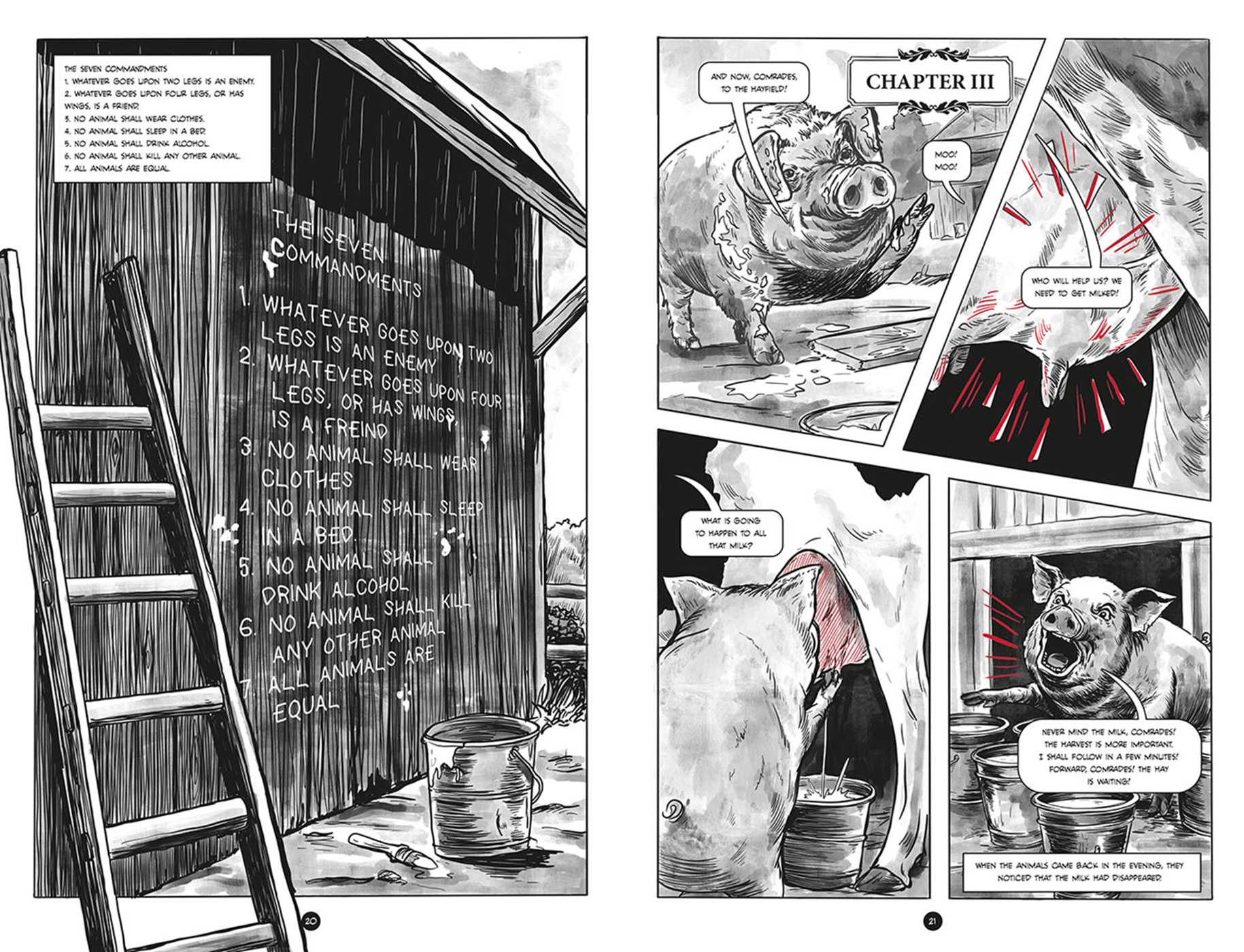
Consider what happens right after inscribing the Seven Commandments:
“Now, comrades,” cried Snowball, throwing down the paintbrush, “to the hayfield! Let us make it a point of honour to get in the harvest more quickly than Jones and his men could do."
But at this moment the three cows, who had seemed uneasy for some time past, set up a loud lowing. They had not been milked for twenty-four hours, and their udders were almost bursting. After a little thought the pigs sent for buckets and milked the cows fairly successfully, their trotters being well adapted to this task. Soon there were five buckets of frothing creamy milk at which many of the animals looked with considerable interest.
“What is going to happen to all that milk?” said someone.
“Jones used sometimes to mix some of it in our mash,” said one of the hens.
“Never mind the milk, comrades!” cried Napoleon, placing himself in front of the buckets. “That will be attended to. The harvest is more important. Comrade Snowball will lead the way. I shall follow in a few minutes. Forward, comrades! The hay is waiting."
So the animals trooped down to the hayfield to begin the harvest, and when they came back in the evening it was noticed that the milk had disappeared.
Notice how Snowball hurries the animals. “Now, comrades, […] to the hayfield!” and sends them to work. This is something a leader would do, but… who appointed Snowball or Napoleon as such? If you recall, Old Major’s speech established that “all animals are equal” and, up to here, the farm’s ownership had been evident on the collective’s actions: they had renamed their farm, they had won over the humans, they met in general assemblies to put forth resolutions, they cast votes of equal value, they ruled.
This sudden pig leadership should have given the animals some pause… but just as before, they did not react—not even to challenge Snowball’s command. Granted, the request of working the hayfields seemed reasonable (as the animals would need the food), and it was a known and familiar task given that their so-called ‘job’ at the farm was to work the land and produce food. So could it be that something else was at play here?
To answer that question we must return to the pig’s lack of clear intentions.
Even though the text is not explicit, we could argue that Snowball, Napoleon, and Squealer created Animalism to win over the animals public opinion. Why? Because, as Francis Fukuyama argues5, “political power ultimately rests upon recognition”, where recognition is defined as “the degree to which a leader or institution is regarded as legitimate and can command the respect of a group of followers.” In the novel, then:
- Mr Jones lost the respect of the animals—what in modern terms we’d call a severe dip in popularity…
- Though between Old Major’s death and the Rebellion, Snowball and Napoleon had managed to secure that respect. That respect was, in turn, the collective’s public opinion, and so the source of the pig’s legitimacy.
How did the pigs manage this, then?
Again, to find the answer we must continue with Fukuyama’s idea of legitimisation5: “[p]eople may follow out of self-interest, but the most powerful political organisations are those that legitimate themselves on the basis of a broader idea.”
The pigs had developed Animalism and so—in the animals’ mind—they spoke as the custodians of the Seven Commandments. When the Rebellion was over and organisation was needed, the pigs’ requests were not challenged because by developing Animalism and teaching it to the others, Snowball and Napoleon had been perfecting the mechanism to legitimate their ascent into political power. They had done so in a pacific, non-rebellious way using the exact mechanism Fukuyama describes: authority resting not on coercion but on recognition of “a broader idea”.
This take over was subtle and easy to ignore… just like the milk’s disappearance was:
So the animals trooped down to the hayfield to begin the harvest, and when they came back in the evening it was noticed that the milk had disappeared.
What did the animals do about it? Nothing, because that line marks the end of Chapter II, and Chapter III begins several months ahead, once the summer is over, the hayfields harvested, and the animals allegedly enjoying a time of opulence. Their lack of a reaction is why, in his 1946 letter to Dwight Macdonnald—editor of the American journal Politics—George Orwell wrote8:
The turning point of the story was supposed to be when the pigs kept the milk and apples for themselves […]. If the other animals had had the sense to put their foot down then, it would have been all right.
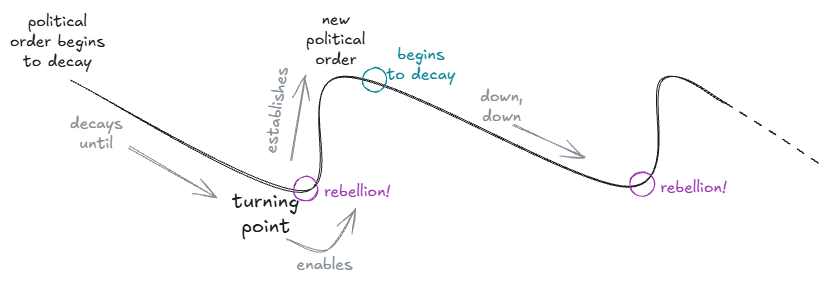
“The turning point” where the cycle of political decay began anew.
To understand why, we must first consider what happened at the end of that summer when the milk’s fate was clarified:
The mystery of where the milk went to was soon cleared up. It was mixed every day into the pigs’ mash. […]
At this some of the other animals murmured, but it was no use. All the pigs were in full agreement on this point, even Snowball and Napoleon. Squealer was sent to make the necessary explanations to the others.
“Comrades!” he cried. “You do not imagine, I hope, that we pigs are doing this in a spirit of selfishness and privilege? Many of us actually dislike milk and apples. I dislike them myself. Our sole object in taking these things is to preserve our health. Milk and apples (this has been proved by Science, comrades) contain substances absolutely necessary to the well-being of a pig. We pigs are brainworkers. The whole management and organisation of this farm depend on us. Day and night we are watching over your welfare. It is for your sake that we drink that milk and eat those apples. Do you know what would happen if we pigs failed in our duty? Jones would come back! Yes, Jones would come back! Surely, comrades,” cried Squealer almost pleadingly, skipping from side to side and whisking his tail, “surely there is no one among you who wants to see Jones come back?"
Now if there was one thing that the animals were completely certain of, it was that they did not want Jones back. When it was put to them in this light, they had no more to say. The importance of keeping the pigs in good health was all too obvious. So it was agreed without further argument that the milk and the windfall apples (and also the main crop of apples when they ripened) should be reserved for the pigs alone.
Let us take a closer look at this scene, to unravel what Orwell was showing us.
-
“The mystery of where the milk went […]” is a triple-duty sentence. First, it suggests that the disappearance was not a once-off event, but something that had continued every day since the Rebellion. Second, its particular turn of phrase hints that the animals gossiped about it so frequently it was now known as “the mystery”. Third, and using the same mechanism of omission from before, the narrative tells us that the animals talked… but not what came of it; the silence around any consequence implies there wasn’t one.
-
The dissent was minimal: “At this some of the other animals murmured” though they were so few, and perhaps their complaints so quiet, that “it was of no use.” Remember what Fukuyama taught us5: “it is the perceived legitimacy of the government that binds populations together and makes them willing to accept its authority.” Given that most animals still believed in the pigs and had no reason to distrust them, what those few others voices said fell on deaf ears.
-
Seeing this, the pigs sent Squealer—often read as a stand-in for propagandist rhetoric. His approach was premeditated:
- It preemptively named what the others could accuse the pigs of (“You do not imagine, I hope, that we pigs are doing this in a spirit of selfishness and privilege?”) to put the animals in the defensive.
- Then, it argued that eating the milk and apples was not a privilege but a sacrifice (“Many of us actually dislike milk and apples”), presenting it as something done for the other animals (“The whole management and organisation of this farm depend on us [pigs]”).
- It was followed by remarks about scientific findings that seemed truthful and grounded but the other animals—many of which were illiterate—had no way of corroborating. They could only question it, or take it at face value.
-
Finally, before the collective could question him, Squealer closed with a threat that linked back to the very reason for the animals’ rebellion: “Do you know what would happen if we pigs failed in our duty? Jones would come back! Yes, Jones would come back!”
Fukuyama’s framework applies here: “people may follow out of self-interest” (and the collective’s self-interest was to keep Mr Jones away from the Farm) “but the most powerful political organisations are those that legitimate themselves on the basis of a broader idea”. Which ideas, then?
- What Animalism had established: humans are the source of all evil and must be hated.
- What the animals had experienced: Mr Jones’ abuse and neglect.
- What Squealer was telling them: that the pigs needed to be in power and enjoy a few privileges (milk and apples) to prevent Mr Jones’ return—which would imply the return of that monarchic political order where the animals were little more than slaves.
Sounds flimsy? Well, the politics of hate and fear seldom survive scrutiny, and Orwell was not precisely discreet in his critique. What matters here is that Squealer’s words were taken as a reason for Snowball’s and Napoleon’s legitimate ascent to leadership.
So begun a new cycle of political decay.
So far we have seen one arc of descent. It began with the revolution against decay (overthrowing Mr Jones), and rose to a new political order legitimised via public opinion. The problem is that history doesn’t end there; the animals did not enjoy a “happy ever after” because societies are constantly in flux, and every political order established in response to specific circumstances will either (a) fail to adapt and decay by stagnation, or (b) be captured by an elite, who then substitute actual accountability for manufactured legitimacy to mask the capture.
Accountability were the Seven Commandments, the general assembly, the votes of equal value—namely, the real mechanisms that allow a society to keep its leaders in check. Legitimacy, as we discussed, was provided by Animalism—the reasons as to why a society believes that a ruler is entitled to rule. Up to the milk-and-apples situation, accountability and legitimacy were balanced… but that balance changed with Squealer’s twist, slowly beginning the erosion of actual accountability with manufactured legitimacy.
When we reviewed the origin of the Seven Commandments of Animalism, I mentioned that the pigs had summarised them into a motto every animal had learnt by heart: “Four legs good, two legs bad.” The sheep—often interpreted as the uneducated masses—became adept at bleeting it during the debates in the general assemblies and so turned into a mechanism to manufacture legitimacy on-demand in opposition to the actual mechanisms of accountability. After all, their chanting drowned the doubts of the animals, preventing them from formulating uncomfortable questions that Napoleon could not answer without revealing his corruption.
And here is a problem: there is not much difference between ‘real’ legitimacy and ‘manufactured’ legitimacy. Traditional legitimacy, charismatic legitimacy, ideological legitimacy—all of it is, in a sense, manufactured in that it has to be actively produced and maintained by whoever holds power. At the end of the day, legitimacy, however produced, is one of the things a ruler needs to hold power.
The wrinkle is that, regardless of how strong that legitimacy is, the mechanisms of accountability cannot be destroyed at once without risking a violent uprising. This is why Napoleon does not outright abolish the institutions but slowly hollows them out from within by keeping the forms:
- The pigs overpowered the general assemblies until only them presented resolutions.
- The debates became, almost exclusively, discussions between Snowball and Napoleon.
- Until, one day, Napoleon called his dogs—which he stole from their mothers and reared privately—to chase Snowball out of the farm… and the animals where too shocked to react.
- From there, Squealer manufactured evidence that Snowball had been colluding with Mr Jones and other humans, again legitimising Napoleon’s authority.
- Napoleon kept the general assemblies, but then reduced them to a mere distribution of orders… first by himself, then by Squealer, then stopped entirely.
- And from then, the pigs breached the farmhouse—which that unanimous resolution had declared a museum, and
- every Commandment while sending Squealer to secretly amend the writings in the barn’s door by night.
As Fukuyama suggested, “[r]ules” (such as the Seven Commandments) “or institutions” (such as the debates and the general assembly) “created in response to one set of environmental circumstances” (namely, Mr Jones’s neglect and abuse) “become dysfunctional under later conditions but they cannot be changed due to people’s heavy emotional investment in them”5. The animals knew Animalism had quote-on-quote ‘saved’ them from Mr Jones, and so believed in Animalism and the idea that Animal Farm was theirs and not Napoleon’s or the pigs’—in spite of all the evidence.
Consider this passage:
The animals huddled about Clover, not speaking. The knoll where they were lying gave them a wide prospect across the countryside. Most of Animal Farm was within their view […] Never had the farm—and with a kind of surprise they remembered that it was their own farm, every inch of it their own property—appeared to the animals so desirable a place. As Clover looked down the hillside her eyes filled with tears. If she could have spoken her thoughts, it would have been to say that this was not what they had aimed at when they had set themselves years ago to work for the overthrow of the human race. […] Instead—she did not know why—they had come to a time when no one dared speak his mind, when fierce, growling dogs roamed everywhere, and when you had to watch your comrades torn to pieces after confessing to shocking crimes. There was no thought of rebellion or disobedience in her mind. She knew that even as things were they were far better off than they had been in the days of Jones, and that before all else it was needful to prevent the return of the human beings.
This was not about Clover, not about the other animals either. This was about the consequences of Napoleon’s manufactured legitimacy.
Political science assumes that a society would retain enough capacity to eventually recognise decay and act. Orwell, as I see it, was using Animal Farm to describe something closer to an epistemic capture—after all, what that passage about Clover shows us is that Squealer’s propaganda and the sheep’s bleeting had not merely delayed a reckoning with political decay, but dismantled the animals’ capacity to perceive it at all..
That is why, at the end of the novel, the animals see the new state… and do nothing about it.
Not even after the pigs amended the last Commandment of Animalism—just as they had done with all the others—to turn it into this:
All animals are equal, but some animals are more equal than other.
And not even after everything returns to what it was, during Mr Jones’s abusive reign:
After that it did not seem strange when next day the pigs who were supervising the work of the farm all carried whips in their trotters. It did not seem strange to learn that the pigs had bought themselves a wireless set, were arranging to install a telephone, and had taken out subscriptions to John Bull, Tit-Bits and the Daily Mirror. It did not seem strange when Napoleon was seen strolling in the farmhouse garden with a pipe in his mouth—no, not even when the pigs took Mr Jones’s clothes out of the wardrobes and put them on, Napoleon himself appearing in a black coat, ratcatcher breeches and leather leggings, while his favourite sow appeared in the watered silk dress which Mrs Jones had been used to wear on Sundays.
“It did not seem strange”. How many times did Orwell repeat that passage, as if it weren’t the narrative saying it, but they: the collective of animals, the society which had now lost the ability perceive decay… even though some of them had lived in the time before the Rebellion.
A week after those changes, the animals see a handful of humans arriving to the farm and marching to the farmhouse—the very same they’d all collectively resolved to keep untouched as a museum. Thus, they peer through the window and, at the very end of the novel, see this:
Twelve voices were shouting in anger, and they were all alike. No question, now, what had happened to the faces of the pigs. The creatures outside looked from pig to man, and from man to pig, and from pig to man again: but already it was impossible to say which was which.
This ending is not about the postponement of the consequences; this is about Napoleon’s victory, and how he managed to remove the precondition for any future revolution because rebellion—in Animal Farm, and often also in real-life—requires an observer capable of naming the gap between principle and practice. That perception is, without a doubt, the most fundamental condition under which correction could ever be recognised as necessary.
Animal Farm, a fable like no other and a book with layers of meaning under layers of meaning. If you liked this episode, you may want to check my other episodes discussing Orwellian themes:
- I did an analysis of Newspeak—the fake language Orwell developed for 1984—covering its key uses for propaganda. This was part of the first season of Books Undone because, as you can see, I never stray too far from political philosophy.
- I also covered 1984 alongside V for Vendetta and The Dispossessed in an analysis about censorship and the death of ideas.
- Finally, using the example of Tender is the Flesh by Agustina Bazterrica, I covered how doublespeak—a concept inspired in Newspeak—can be used to manipulate public opinion.
- And if you are interested in the latter, I have a very thorough analysis of Dune by Frank Herbert, covering political theory and the use of an engineered religion to legitimise political power.
You can find all the episodes in booksundone.com. And if highly thematic books with complex political settings interest you, please check the first book in my own series, The Omens of War; it is available wide in ebook and paperback, so I’ll leave all links in the episode’s description.
Thanks for listening, and happy reading.
-
Quotes on his personal history were taking from Orwell’s preface to the Ukranian Edition of Animal Farm. The original English version of this preface was lost, and so it was re-translated back to English from the Ukrainian version by Ihor Szewczenko. It is now available as an appendix in some ebook and paperback versions. More than talking about the book, it sheds light on Orwell’s life. ↩︎ ↩︎ ↩︎
-
Curiously, this is part of the United Kingdom’s National Archive: George Orwell’s Surveillance ↩︎
-
It seems that the original proof of Animal Farm (from 1937) included space for a preface written by Orwell himself. This preface was… quot-on-quote ’lost’ for almost four decades until it was found by Ian Angus, and published in The Times Literary Supplement on September 15th, 1972. This preface was titled “The Freedom of The Press”, and has now been reprinted and incorporated in a number of modern editions of Animal Farm. Still, once has to wonder whether ’lost’ is accurate. ↩︎ ↩︎
-
In fact, within the book, the animals design a new flag for the farm, once they have retaken it from the humans. The flag’s shape, and the elements depicted on it, are not too different from the flag of the Soviet Union. Orwell was not subtle in his allegory. ↩︎
-
From “The Origins of Political Order” by Francis Fuyakama. A dense book, but excellent if political science is of your interest. ↩︎ ↩︎ ↩︎ ↩︎ ↩︎ ↩︎ ↩︎
-
The full definition of ideology, by Michael Freeden, can be read in the Routledge Encyclopedia of Philosophy, under DOI 10.4324/9780415249126-S030-1. Access it for free here. ↩︎ ↩︎
-
If Old Major’s words have a communist flavour to them, a reader wouldn’t be imagining it. A common interpretation is that Old Major was partly inspired by Vladimir Lenin—the leader of the Bolshevik Revolution—and partly by Karl Marx, the German philosopher, social and political theorist who was also a revolutionary socialist. He developed the theory of historical materialism, analysing societal structure and change, particularly class struggle under capitalism—all the theories that later fuelled the Russian Revolutions. ↩︎
-
An excerpt of George Orwell’s response to Dwight Macdonald is available in “‘Animal Farm’: What Orwell Really Meant”, archived by The New York Review in the July 2013 issue. It is publicly available: https://www.nybooks.com/articles/2013/07/11/animal-farm-what-orwell-really-meant/ ↩︎


